[ BIO ]■
Wheeler's work defies classification. Dissonance, disjunction and discord describe the disparate themes Wheeler weaves together in his combinations of unexpected imagery. From his earliest exhibition, Wheeler has never been reluctant to confront big issues. Social faux pas do not register in Wheeler's practice. He shamelessly makes verbose claims, belying his personal opinion on themes including religion, sex and politics.

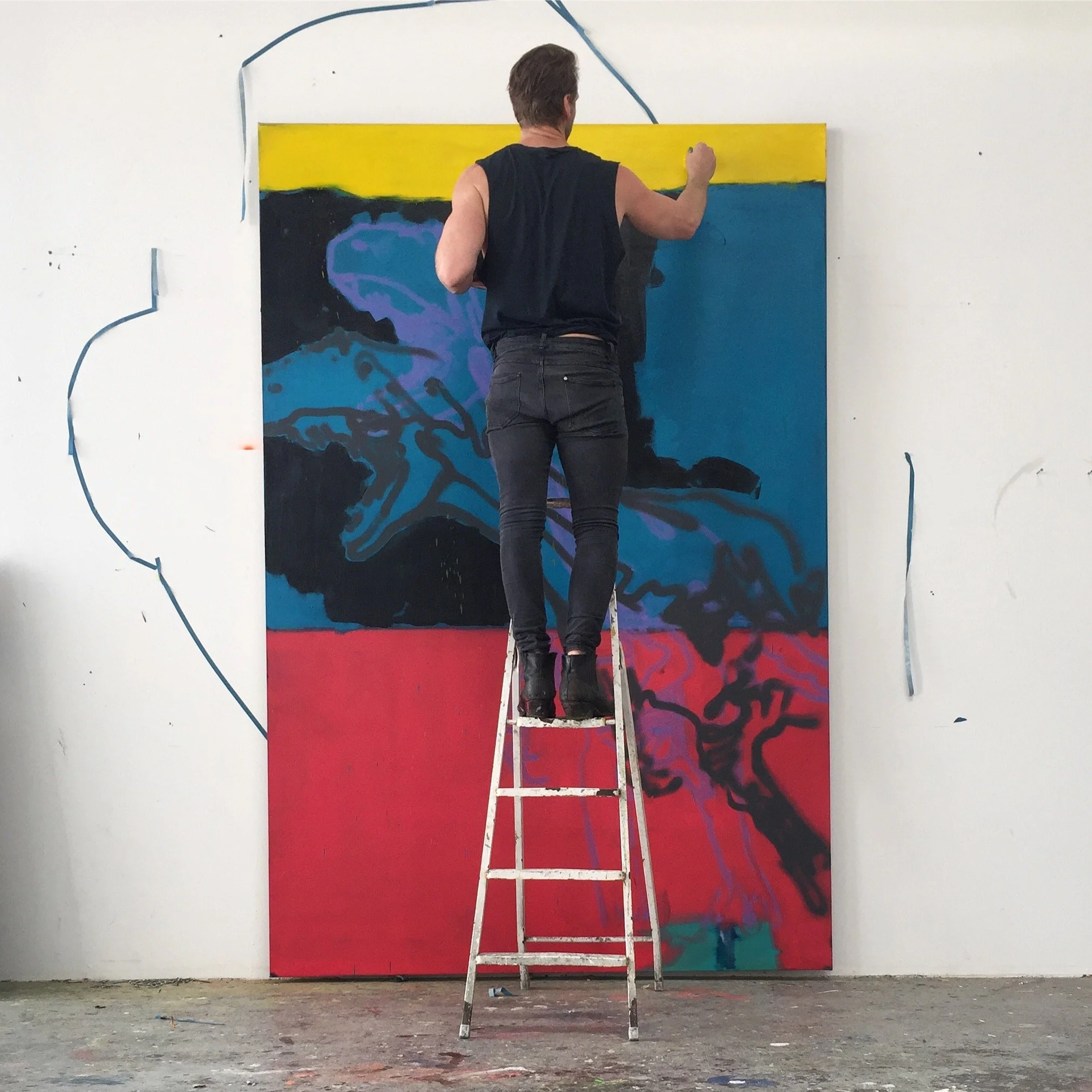
He has exhibited extensively at home and abroad. Many of his works are held in collections both nationally and internationally. Pete spent 14 years living and working as an artist in Berlin, Germany. In 2021 he moved back to Broad Bay, Dunedin (his home city where he studied fine art) with his family.
Pete Wheeler is a contemporary painter who has had a career span more than two decades.
You can tell straight off the bat that Pete Wheeler is serious about painting. But is he serious about what he paints? Back in 2007, Wheeler made a picture called Everytime I show I put my ass on the line. It has got all the ingredients of a bad album cover for a lame band of self-styled rebels—above all, a skull, that great, gothic, doom-laden emblem, beloved by the Romantics (Lord Byron drinking wine from the skull of a monk, and all that stuff). There is also a harlequin diamond pattern; to the right, a slum tenement (perhaps); below, the phrase ‘what the hell’ (no question mark); and the whole surface of the work looks like it is bleeding. Its title (‘everytime’ is not a proper word) speaks of the tortured individual who gives his all, whose efforts—inspired, honest, full of pain and risk—become grist to the art world’s mill.
A serious artist of the twenty-first century is unlikely to wholeheartedly buy into such angst-laden, old-hat ideas about the creative genius. On the other hand, he might get a kick out of performing that role, rehashing its most blatant signifiers.
Fast-forward to 2014’s The Song is Heroic. The imagery is more ambiguous. The process has evolved to include the use of photographic emulsion and chloride besides oil paint. Wheeler tackles the idea of painting as alchemy, giving it both a literal treatment (smear on the gold leaf) and a more convoluted working out, layering and scraping the surface with a view to arriving at something that transcends its materiality. But it is still an archaic reference to the trials and powers of the artist, with a title snipped from one of singer-songwriter Nick Cave’s lugubrious monologues about confronting death and slaying dragons (difficult to tell if he is serious too).1 In common with the earlier painting is the harlequin pattern, here more integral to the structure of the picture. Pablo Picasso’s harlequin figures come to mind (see his 1905 Saltimbanques), but countless artists have made reference to this clown or trickster character of the Italian commedia dell’arte. Harlequin tends to be subservient but subversive, a performer, a rebel, but also an outsider—one who, through jest and flourish, points up the absurdities of the broader social context. For numerous artists of the romantic period, a clown or street performer, in the form of Harlequin or Pierrot, stood for the artist, spurned or misunderstood by the general public.2 To what extent does Wheeler identify with this figure?
Born in Timaru in 1978, Wheeler studied at the Dunedin School of Art before breaking into the Auckland scene, all guns blazing, with a show called I went looking for one good man at Whitespace in 2004, and a volley of barbs directed at the big bad art world.
He would head off to conquer Berlin in 2007, where he has since mostly been based, committed full time to painting. His primary patron in New Zealand has been Sir James Wallace, and the Wallace Arts Trust recently staged a significant survey of work from 2004 to the present at the Pah Homestead, accompanied by a fine catalogue with nice big images and a lively text by Andrew Paul Wood. Meanwhile, Wheeler has made a Covid-prolonged return to his old Dunedin stomping ground, and had a small but cohesive exhibition at RDS Gallery, also accompanied by an informative catalogue (essays by Alistair Fox, Michael Greaves and Hilary Radner). Perhaps settling in Dunedin will raise Wheeler’s profile in New Zealand. In The man who could cry and Same old thing (both 2020), the marginalised Harlequin, now a full-blown figure rather than a mere pattern, does rather look like he has been sent packing. The title of the Pah Homestead survey, Painting Out of Time, might suggest that Wheeler’s paintings are at odds with the central preoccupations of this historical moment (certainly his 2020 History doesn’t repeat / But it rhymes was an oddity in the recent Anthropocenethemed exhibition at the Dunedin School of Art).3 Or it might mean he is running out of time to make his mark, or the world is running out of time, or Wheeler spends a considerable amount of time painting, or he is like a musician failing to keep to tempo, or the paintings merge different moments and transcend any particular period . . . . Whatever the case, ‘It is timely’, Hilary Radner writes, ‘to acknowledge his status as one of the significant artists of his generation.’4 Pete Wheeler’s paintings are consistently big and brushy (‘ballsy’, I can imagine someone saying). They are typically figurative, based on photographs, found online or taken himself, although they sometimes go quite abstract (Gray Goes Black, 2016) and invariably have a rigorous structure (in recent works, some semblance of a grid or a series of stacked rectangles).
Wheeler likes things that stand for rebellion in a masculine, angst-ridden, cheesy, done-to-death kind of way—such as skulls, gothic lettering and birds of prey. Andrew Paul Wood writes that such subjects ‘would often be kitsch if they were not expressionistically painted on a gigantic canvas’.5 But colossal neo-expressionist paintings are kitsch too, surely. Wheeler’s ‘heroic’ style is in keeping with his subject matter—there is no tension between them—which could lead one to the bleak conclusion that the paintings are irredeemable. That would be an overly intellectual response. A skull can certainly kill a painting, and dripping paint can bleed the life out of it too, but it is in the nature of art that you can make it any way you want, about anything, and then it stands or falls on some other basis that no one can quite put their finger on.
If I was to take a stab at it (the critic must), I would say it is something along the lines of a complete vision for the look and feeling of the work, made manifest so that it strikes the viewer too as complete (the vision is complete even if the work itself is full of inconsistencies and contradictions).
To effect a further, more pointed stab, Wheeler’s paintings are better when his visions are more fleshed out; they seem to need a certain depth or layering of surface and space, and they need at least something in them that is recognisable. It is not that there has to be a narrative. I mean, what is going on in the Department of Youth Triptych? Grumpy bird surveys nuclear holocaust? Who knows? But for Wheeler to pull off something this nutty, the subject has to gain more substance than either what it merely looks like or the concepts it generates, while the paint has to do more than cover a surface—to be animated by something to do with the subject, however corny or thorny.
Marcel Duchamp is the subject of many of Wheeler’s most recent works. They tend to be called ‘Self Titled’, in a funny combination of the ‘Untitled’ and the ‘Self-portrait’ (and the entitled?). Duchamp’s first readymade sculpture, Bicycle Wheel (1913), was a blow to the heart of the painting tradition, and an important precedent for the shift from form to concept, and picture to object, that underpins contemporary art. Also, there is no ‘Wheeler’ without ‘wheel’. So our hero has had the brilliantly unlikely idea of painting pictures of the sculpture. In Self Titled #5 (2019), the wheel is consumed by flames, or, rather, by paint—jagged red, orange and yellow shapes. If the wheel is Duchamp, the colour field is Clyfford Still—and then what really makes the painting is neither of those fellows, but a series of less conspicuous blobs.
See those touches of pastel pink and green, emerald green, purple and yellow on the spokes and rim of the wheel, as it glints in the fire? The pink and the pale green appear even more surreptitiously in a halo of light around wheel rim, flames and seat. Wheeler has the know-how to lift a picture, to make you believe in the paint even if you cannot take the image seriously.
In Self Titled #3 (2020), behind an arc of blue tendrils, and in front of three somewhat arbitrary-looking green stripes, we appear to be looking at the visage of Duchamp himself, sprayed onto the canvas in lurid pink, his pipe, held in an awkward, angular hand, emitting green smoke. Wheeler has cruelly overlaid the dopey, heavy-lidded eyes of Homer Simpson. The artist-intellectual possessed by the cartoon idiot: it could be the self-portrait of an artist who does not separate the thinking and the doing, or a statement about what he does with paint—Wheeler sloshes it up against all kinds of things, so that they collapse into each other and you cannot quite tell if the outcome is stupid or profound.
Well, ultimately profound, I am inclined to believe. ‘I like reaching back and pulling things forward’, Wheeler says.6 I suppose he means that he pulls things out of their historical context and into a new one, ‘out of time’, but he could also be talking about value.
Allow me to decode / I’ve come to download (2019–20) shows an abandoned shopping trolley catching autumn leaves in its twisted metal cage, while an ominous abstract grid presses down from above.
Ultimately, for all the braggadocio schtick, Wheeler suffuses his discredited subjects with a gentle, elegiac affection and